 GunSerials
Winchester Model 62 and 62A serial numbers by year
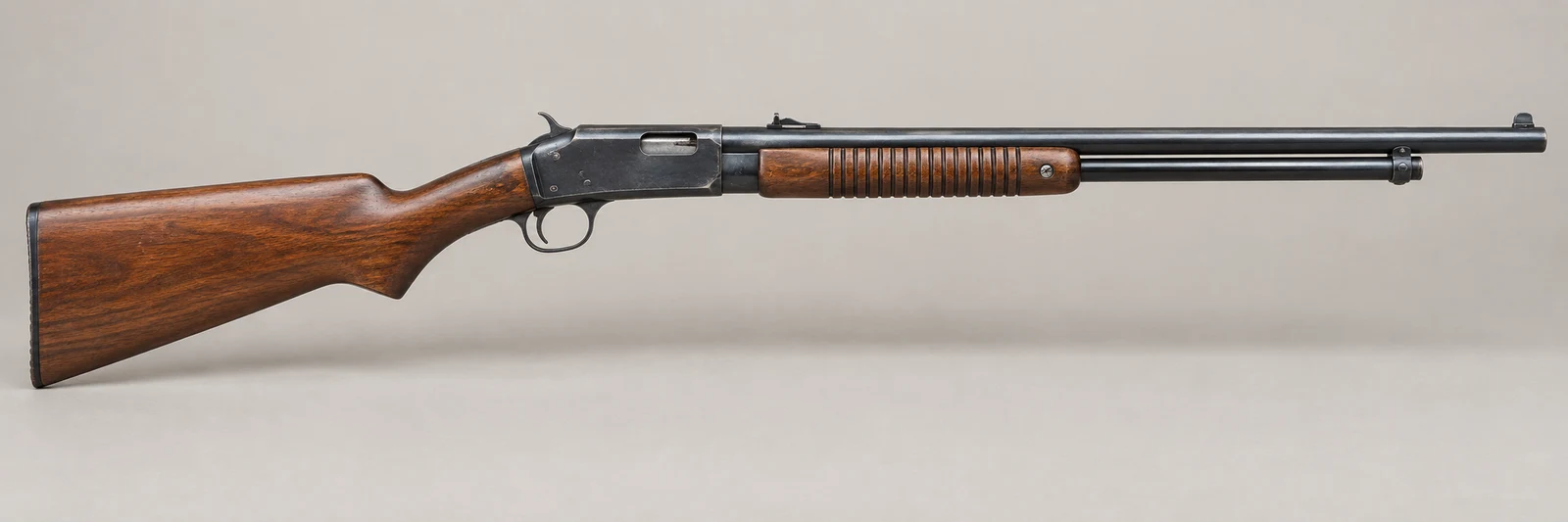
A pump-action .22 with an exposed hammer, developed from the Model 1890 and 1906 gallery rifles. The 62A name arrived with design changes in 1940.
- Produced:
- 1932–1958
- Action:
- pump-action
New to gun terms? Start here
- Model:
- The name of the gun design, such as Model 94. A model name that looks like a year does not tell you when your gun was made.
- Serial number:
- The number stamped on an individual gun. Include letters that are part of the number. A separate letter stamped above it, like the Model 97's C, D or E, is a different marking.
- Receiver:
- The main metal body just behind the barrel. The receiver ring is its front section, where the barrel joins it.
- Tang:
- A strip of metal extending from the receiver into the stock. The lower tang runs underneath, behind the trigger.
- Stock:
- The part you hold against your shoulder, usually made of wood on older Winchesters.
- Forearm or forend:
- The part under the barrel where your forward hand holds the gun.
- Action:
- The mechanism that loads and removes cartridges. Names such as lever action, pump action, and bolt action describe how it works.
- Caliber or gauge:
- The ammunition size or type a gun is designed to use. This marking is different from the model and serial number.
- Takedown:
- A version designed to separate into major sections for storage. A takedown joint is where those sections meet.
- Proof mark:
- A factory testing mark, such as Winchester's oval WP stamp. It is not a serial number or a date code.
- Peep or aperture sight:
- A rear sight with a small hole to look through. A hooded front sight has a cover around it.
What year was your Model 62 or 62A made?
Need help finding the serial number?
Look up a serial number and print a one-page record sheet: the date and its sources, the status by age, the model in brief, and the auction price range.
Winchester Model 62 and 62A value: what it sells for at auction
Enter your serial number above to highlight the price categories that fit the estimated date and see recent sales of this model in those categories.
These prices come from 142 Winchester Model 62 and 62As sold individually at Rock Island Auction Company (21), Morphy Auctions (38), Poulin Auctions (21), Redding Auction Services (22), and Amoskeag Auction Company (40) between Sep 2023 and Sep 2026. The age-group rows use the auction companies' categories: antique, curio and relic, or modern.
The typical price is the middle price, also called the median. Half sold for more and half for less. The middle 50% range leaves out the lowest quarter and highest quarter of prices. The wider 80% range leaves out the lowest tenth and highest tenth.
We leave out listings described as deluxe, special-order, engraved, restored, or commemorative, and other exceptions in the value guide. Commemoratives are priced on their own page. Wear, repairs, original parts, and factory upgrades can make a particular gun worth more or less. These figures are a comparison, not an appraisal of your gun.
| Category | Sales | Middle 50% of prices | Typical price | Middle 80% of prices |
|---|---|---|---|---|
| Curio & Reliccollector category, usually 50+ years old | 141 | $544 – $1,008 | $700 | $420 – $2,232 |
Curio & Relic: Rock Island Auction Company typical $1,880 (21 sales); Morphy Auctions typical $800 (37 sales); Poulin Auctions typical $575 (21 sales); Redding Auction Services typical $625 (22 sales); Amoskeag Auction Company typical $665 (40 sales).
Recent Model 62 and 62A auction sales
Sales near the typical price and the newest. Their features and condition may differ from your gun. A lot number identifies an item in an auction.
| Sold | Gun | Auction company | Price |
|---|---|---|---|
| Jul 2026 | Model 62A | Redding lot 372R | $700 |
| Jul 2026 | Model 62 | Redding lot 371R | $700 |
| Nov 2025 | Model 62A | Morphy lot 1568 | $676 |
| Aug 2026 | Model 62A | Amoskeag lot 2574 | $605 |
| Aug 2026 | Model 62A | Amoskeag lot 2566 | $544 |
Prices are in US dollars and include the buyer’s premium, the auction company’s fee added to the winning bid, where the house charges one; Redding charges none. They are not the amount the seller receives. A dealer’s offer or private sale price may differ. The full picture, model by model →
Where the serial number is
On the underside of the receiver in front of the trigger guard, and on the lower tang, the metal strip behind the trigger.
Unboxing the Model 62A
Where these dates come from
The table on this page comes from one source: George Madis's published tables. Use its dates as estimates for groups of serial numbers, and check the notes for its limits.
Source for this model: Published Madis combined Model 62/62A table
Winchester Model 62 and 62A serial numbers by year
The full Model 62 and 62A serial number chart, one table for each source available here. Each row gives the numbers that source assigns to a year. Both the first and last numbers are included.
A row marked “approximate” is a figure we trust less than the rest of its table: a boundary the sources put a few serials apart, or a figure a later record corrects.
George Madis's published tables
George Madis compiled Winchester reference books years after production. His tables estimate the last serial number reached each year.
Cited as: Published Madis combined Model 62/62A table
| Year | Serial numbers |
|---|---|
| 1932approximate | 1 – 7,643 |
| 1933approximate | 7,644 – 10,696 |
| 1934approximate | 10,697 – 14,092 |
| 1935approximate | 14,093 – 23,926 |
| 1936approximate | 23,927 – 42,762 |
| 1937approximate | 42,763 – 66,063 |
| 1938approximate | 66,064 – 80,210 |
| 1939approximate | 80,211 – 96,540 |
| 1940approximate | 96,541 – 116,400 |
| 1941approximate | 116,401 – 137,387 |
| 1942approximate | 137,388 – 158,374 |
| 1943–1945approximate | 158,375 – 158,645 |
| 1946approximate | 158,646 – 183,756 |
| 1947approximate | 183,757 – 219,085 |
| 1948approximate | 219,086 – 252,298 |
| 1949approximate | 252,299 – 262,472 |
| 1950approximate | 262,473 – 272,648 |
| 1951approximate | 272,649 – 282,823 |
| 1952approximate | 282,824 – 293,000 |
| 1953approximate | 293,001 – 310,500 |
| 1954approximate | 310,501 – 328,000 |
| 1955approximate | 328,001 – 342,776 |
| 1956approximate | 342,777 – 357,551 |
| 1957approximate | 357,552 – 383,513 |
| 1958approximate | 383,514 – 409,475 |
| 1959approximate | 409,476 – 410,456 |
- 1932–1939, 1941–1942, 1946–1958: This row comes from George Madis's published table, which combines the Model 62 and the Model 62A. Do not read it as Model 62A-only data. The two models share one continuous main serial sequence.
- 1940: This row comes from George Madis's published table, which combines the Model 62 and the Model 62A. Do not read it as Model 62A-only data. The two models overlap during the design changeover.
- 1943–1945: This row comes from George Madis's published table, which combines the Model 62 and the Model 62A. Do not read it as Model 62A-only data. No combined start-of-year figure is published for 1944 or 1945. The next one published is 158,646 for 1946.
- 1959: These are leftover parts assembled in 1959 after regular production ended. George Madis's tables run the combined Model 62 and 62A sequence to about 410,456. That conflicts with Schwing's figure of 412,022 as the last Model 62A number, which is disputed.
What to know about Model 62 and 62A serial numbers
- Treat about serial number 99,200 in early 1940 as a changeover zone, not a sharp cutoff. The Model 62 and the Model 62A share one continuous serial sequence and overlap there.
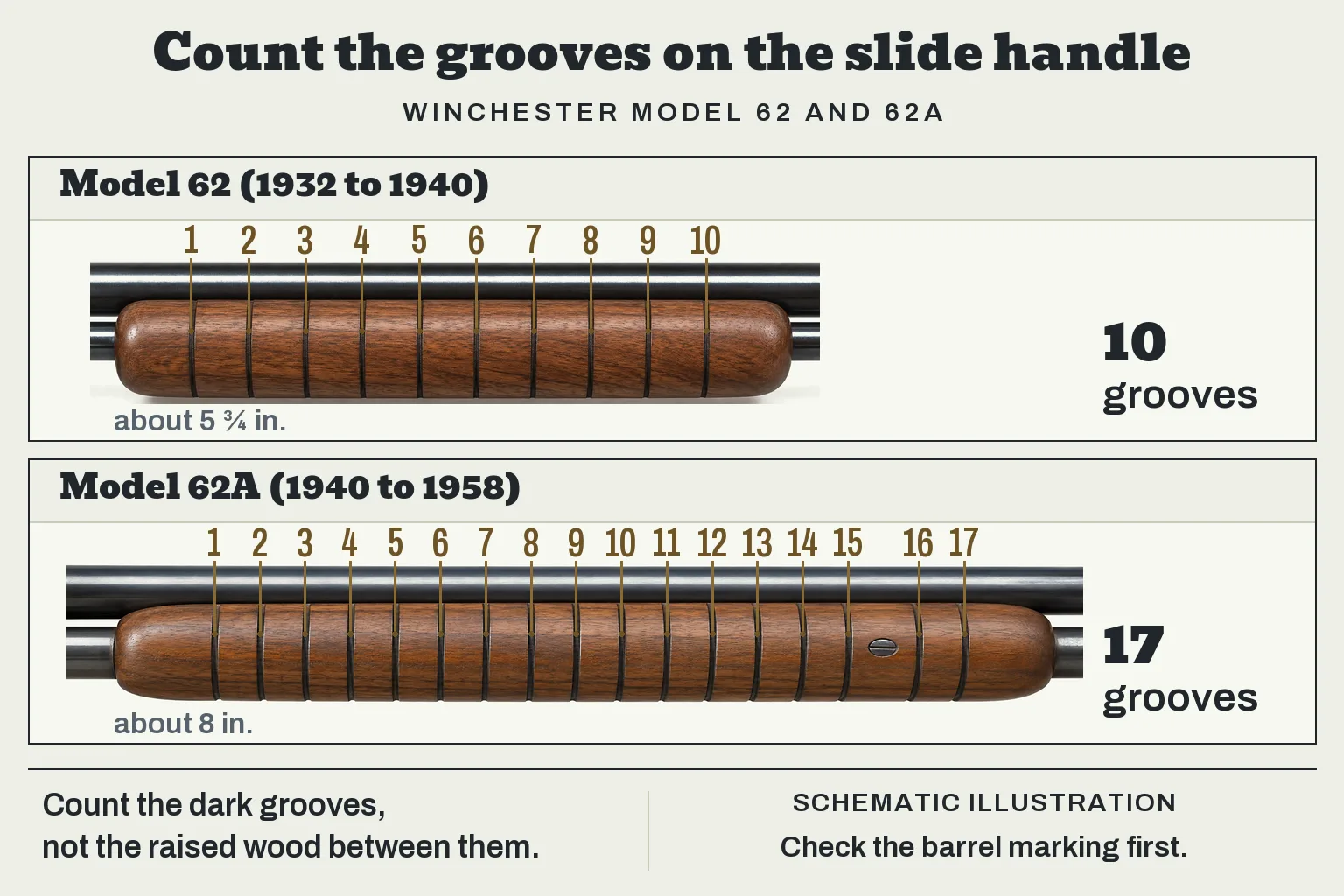
- How to tell a Model 62 from a Model 62A. The barrel is marked MODEL 62 or MODEL 62A, and that is the first thing to check, but the two overlapped in 1939 and 1940, so the marking alone is not final. According to the published references, the 62A changes of 1940 replaced the flat mainspring with a coil hammer spring, lengthened the slide handle from about 5 3/4 inches with 10 grooves to about 8 inches with 17 grooves, and changed the hammer thumbpiece from checkered to grooved. The serial number tables on this page cover both models in one sequence, so the year is the same either way.
- That total covers both models together. It is not a count of Model 62As alone.
- Schwing published 412,022 as the last Model 62A number, but the Winchester collectors' association notes that no one has independently confirmed it.
- George Madis's tables give a family total of 410,456. Schwing gives a final number of 412,022. The two differ by 1,566 serial numbers, and which one is right is disputed.
- Some rifles were built from leftover parts assembled after regular production ended. They use older Model 90 and 06 series receivers numbered about 846,023–854,757. Some carry an A or B after the number. These are not a continuation of the ordinary 410,000 series.
- Known rifles have receivers that were numbered years before their barrels were made and the rifle was put together. One receiver recorded in 1942 was later fitted with a 1953 barrel.
- The approximate last serial number of each year was worked out from published start-of-year numbers and the number made. A dash means no separate figure is published for that year.
Related models, and why
These models share a number sequence, replaced this model, or look similar. Each link explains the connection.
Winchester rifles usually made without serial numbers
These models usually have no serial number. Their pages explain the exceptions and how their features may help estimate age.
Need more detail? Check for factory records
The Cody Firearms Records Office can check for surviving records for your serial number. For a fee, it can issue a letter reporting what they say. Some records contain only dates; others also describe the gun’s original features.
The office’s May 2024 coverage sheet lists these Model 62 and 62A serial numbers: 151,251–167,688. Check current availability with the office before ordering; a listed range does not guarantee a record for every number.
Order a factory letter from the Cody Firearms Museum →What a factory letter shows, and when one is worth ordering →