Winchester deluxe and special-order features to look for on your gun
Winchester built its guns in many combinations of wood, barrel, sights, and finish, and the factory wrote those choices down. Learn to recognize the features, and what the records can tell you about your own gun.
A single rifle can bring several special features together.Model 1886 made in 1901. Metropolitan Museum of Art, public domain.
01 / Get to know the details
What are you looking at?
Choose a feature. The photograph zooms to show it, and the notes explain the term, what to check on your gun, and which published factory records name the feature.
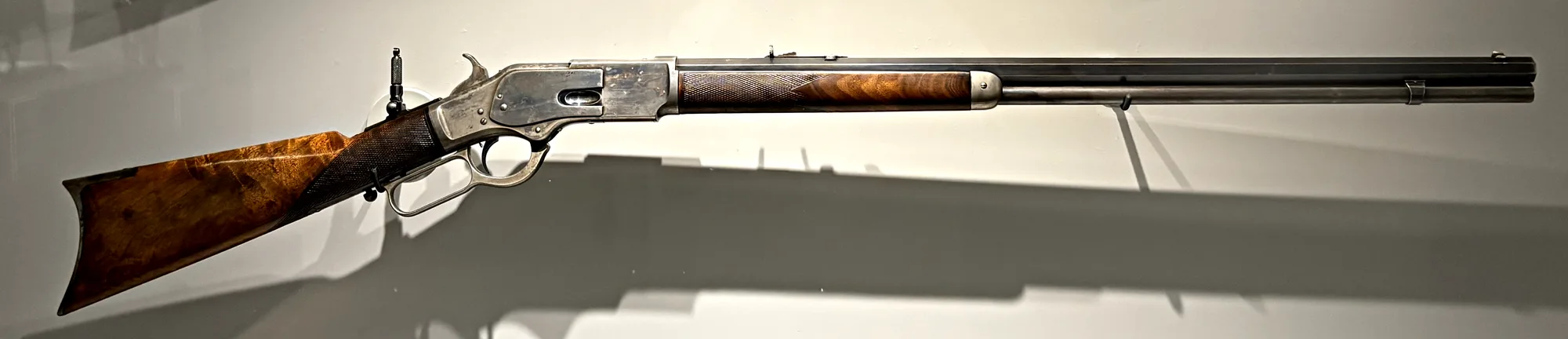
Flat sides along the barrel, each catching the light as a separate band, with the full-length magazine tube beneath. Model 1873 rifle, about 1875. Photo by Gabon100, Wikimedia Commons, CC BY-SA 4.0.
Barrel and magazine
Octagon barrel
A barrel with eight flat sides on the outside instead of a round surface. A half-octagon barrel is flat-sided near the receiver and round toward the muzzle. Records name the shape, and sometimes the length.
Round
Octagon
Half-octagon
Seen from the muzzle, then from the side. Flats on an octagon barrel show from the side as bands of light. On a half-octagon barrel the flats stop part way and the rest is round.
On your gun
Look along the barrel from the side. Flats catch the light in bands. Check whether the flats run the whole length or change to round part way.
Where the records show it (4)
Factory records photographed and published with these auction lots. The link goes to the lot.
Model 1885, 1905: Half-octagon No. 3 barrel, Schuetzen set trigger, checkered pistol-grip stock, mid-range and wind-gauge sights, Helm buttplate. Morphy Auctions, lot 515816
Barrel and magazine
Half magazine
The magazine is the tube under the barrel that holds cartridges. On most rifles it runs almost to the muzzle. A half magazine is shorter, so the gun holds fewer rounds and weighs less. Records list it as a separate choice from the barrel.
On your gun
Compare the end of the tube with the end of the barrel. If the tube stops near the middle of the barrel, the gun has a half magazine.
Where the records show it (5)
Factory records photographed and published with these auction lots. The link goes to the lot.
Model 1876, 1881: Round 26-inch barrel, checkered pistol-grip stock, half magazine, shotgun butt, case-hardened. Morphy Auctions, lot 564889
Model 1876, 1880: Octagon barrel, checkered pistol-grip stock, half magazine, shotgun butt. Morphy Auctions, lot 285334
A takedown gun separates into two main sections, barrel and action, for carrying or storage. The joint sits just in front of the receiver. Records for several models list takedown as a feature of the gun as built.
On your gun
Look for a visible seam or ring just ahead of the receiver, sometimes with a latch or a threaded collar. A takedown joint is a factory feature, not damage.
Where the records show it (6)
Factory records photographed and published with these auction lots. The link goes to the lot.
The shape of the stock where your hand rests behind the trigger. A straight grip runs in a line toward the butt. A pistol grip curves downward, like a pistol's handle. Records name the grip shape on its own, so a pistol grip can be plain, checkered, or carved.
On your gun
Look at the wood just behind the lever or trigger. A downward curve with a cap on the end is a pistol grip. Whether the wood is also checkered is a separate question.
Where the records show it (4)
Factory records photographed and published with these auction lots. The link goes to the lot.
Model 1876, 1881: Round 26-inch barrel, checkered pistol-grip stock, half magazine, shotgun butt, case-hardened. Morphy Auctions, lot 564889
Rows of small crossing cuts that form a diamond pattern in the wood, giving the hand a grip. Records say "checkered stock" when the factory cut it. Some records specifically say "not checkered", which tells you the fancy wood was left smooth.
On your gun
Run a finger over the grip and forend. Checkering feels like fine texture and shows as a diamond pattern. Later added checkering exists, so the record is the test of factory work.
Where the records show it (4)
Factory records photographed and published with these auction lots. The link goes to the lot.
Model 1873, 1875: Bird's-eye maple checkered stock, set trigger, octagon barrel, case-hardened. Morphy Auctions, lot 642094
Model 1873, 1879: Full nickel finish, checkered stock, set trigger, octagon barrel. Morphy Auctions, lot 515784
Model 1876, 1882: Octagon barrel, set trigger, checkered pistol-grip stock, sling and swivels. Morphy Auctions, lot 564853
Stock and wood
Carving
Designs cut into or raised from the wood, such as leaves, scrolls, or borders. Carving is a different feature from checkering, and Winchester's records name carving styles separately.
On your gun
Look for shapes standing above or sunk below the surface of the stock, rather than the even diamonds of checkering. Carving usually appears at the grip and on the forend.
Where the records show it (2)
Factory records photographed and published with these auction lots. The link goes to the lot.
Wood chosen for its grain rather than the plain walnut used on standard guns. Records say "fancy", sometimes with a wood grade, and sometimes name a species such as bird's-eye maple or Circassian walnut.
On your gun
Look for waves, flames, or small round "eyes" in the grain. Plain wood is even in color with little pattern. Fancy wood is a separate choice from checkering or carving.
Where the records show it (6)
Factory records photographed and published with these auction lots. The link goes to the lot.
Model 21, 1941: Custom finish, Circassian walnut, full stock measurements and weight. Morphy Auctions, lot 590361
Stock and wood
Shotgun butt or rifle butt
The standard Winchester rifle butt is a crescent-shaped steel plate that curves around the shoulder. A shotgun butt is flat or gently curved, like a shotgun's, usually with a steel or hard rubber plate. Records list the shotgun butt as a choice, and occasionally say "rifle butt" to make clear it was not chosen.
On your gun
Look at the end of the stock from the side. A nearly flat end is a shotgun butt; a deep crescent is a rifle butt. The plate material and any pad are separate details a record may mention.
Where the records show it (7)
Factory records photographed and published with these auction lots. The link goes to the lot.
Model 1876, 1881: Round 26-inch barrel, checkered pistol-grip stock, half magazine, shotgun butt, case-hardened. Morphy Auctions, lot 564889
Model 1876, 1880: Octagon barrel, checkered pistol-grip stock, half magazine, shotgun butt. Morphy Auctions, lot 285334
Designs cut into the metal, from simple borders to full scenes with gold inlay. Winchester sold engraving in numbered styles at set prices, and some records give the style number or the price charged.
On your gun
Look at the sides of the receiver, the metal body behind the barrel. A record that gives a style number or price is strong evidence the factory did the work. Engraving added later is common.
Where the records show it (5)
Factory records photographed and published with these auction lots. The link goes to the lot.
A bright silver-colored plating over the steel. "Full nickel" covers the whole gun. "Half nickel" or "nickel trim" covers the receiver and small parts while the barrel stays blued.
On your gun
Nickel looks bright and silvery and wears to a dull gray. Blued steel is dark blue-black. Check which parts are plated and compare with what the record says.
Where the records show it (5)
Factory records photographed and published with these auction lots. The link goes to the lot.
Model 1873, 1879: Full nickel finish, checkered stock, set trigger, octagon barrel. Morphy Auctions, lot 515784
Model 1873, 1886: Nickel receiver and trim, set trigger, 28-inch octagon barrel. Morphy Auctions, lot 612835
Model 1873, 1893: Fancy stock, gilt and nickel finish, engraving priced at $2.50, 15-inch barrel. Morphy Auctions, lot 610446
Metal and finish
Case-hardened finish
A heat treatment that leaves swirls of blue, gray, and straw color on the receiver and other parts. Early rifle records often say "case hardened" alongside the other features.
On your gun
Look for mottled colors on the receiver rather than an even blue. The colors fade with handling, so an old gun may show only traces.
Where the records show it (4)
Factory records photographed and published with these auction lots. The link goes to the lot.
Model 1876, 1876: Half-octagon barrel, checkered pistol-grip stock, long-range sights, case-hardened. Morphy Auctions, lot 560831
Model 1873, 1875: Bird's-eye maple checkered stock, set trigger, octagon barrel, case-hardened. Morphy Auctions, lot 642094
Model 1876, 1881: Round 26-inch barrel, checkered pistol-grip stock, half magazine, shotgun butt, case-hardened. Morphy Auctions, lot 564889
Sights
Special sights
Winchester fitted many sights beyond the standard open rear sight: folding peep sights on the tang behind the hammer, express sights with several folding leaves, and target sights with fine adjustments. Records often name the maker or type.
On your gun
Look on the tang behind the hammer, on the barrel near the receiver, and at the muzzle. A record naming a sight helps show whether it was fitted at the factory.
Where the records show it (6)
Factory records photographed and published with these auction lots. The link goes to the lot.
Model 1885, 1905: Half-octagon No. 3 barrel, Schuetzen set trigger, checkered pistol-grip stock, mid-range and wind-gauge sights, Helm buttplate. Morphy Auctions, lot 515816
A visible feature is a clue, not proof of factory work. Checkering, engraving, and sights were all added to guns after they left New Haven. The record for your serial number is the test.
Also in the records
Not pictured here
Extra light or extra heavy barrel
Winchester recorded barrel weight as a choice. Extra Light means a slimmer, lighter barrel and gun. Extra Heavy means a thicker one, often for target shooting. On the Model 1885 single-shot, a barrel weight number from 1 to 5 describes thickness, not pounds.
On your gun Compare the thickness of the barrel at the muzzle with a standard example of the same model. A very slim or very thick barrel may be a recorded choice.
Model 1885, 1903: Half-octagon No. 5 barrel, 32 inches, fancy pistol-grip stock not checkered, target sights. Morphy Auctions, lot 515845
Stock measurements
Winchester sometimes recorded the stock's dimensions: length of pull from trigger to butt, drop at the comb and heel, and pitch. Model 21 shotgun records often give all of them. A few rifle records give a length or a drop.
On your gun A stock that feels unusually long, short, or bent compared with others of the model may have been made to measure. The record is the only way to confirm it.
Model 21: Standard Grade 16 gauge: 26-inch barrels with chokes named for each, single trigger, pistol grip, beavertail forend, stock measurements. Morphy Auctions, lot 511617
Model 21, 1941: Custom finish, Circassian walnut, full stock measurements and weight. Morphy Auctions, lot 590361
Model 21, 1947: Deluxe Grade Field Gun with full stock measurements and an extra barrel set; final inspection record. Rock Island Auction, sale 4093, lot 523
Cheekpiece
A raised, shaped area on the side of the stock where the cheek rests. It appears in Model 1885 target rifle records, sometimes as a "Schuetzen" cheekpiece, named for the German-style offhand target matches.
On your gun Look at the left side of the buttstock for a raised pad of wood. It goes with other target features: a set trigger, special sights, and a hooked buttplate.
Model 1885, 1907: Schuetzen set trigger, checkered pistol-grip stock, Schuetzen cheekpiece, Helm buttplate, spur lever. Morphy Auctions, lot 515824
Set trigger
A trigger that can be "set" so it releases with a much lighter touch, used for careful target or hunting shots. Records say "set trigger" or "plain trigger". Model 1885 target rifles often have a "Schuetzen" set trigger.
On your gun A set trigger is often paired with a second small trigger or lever inside the trigger guard. This guide does not cover how to operate one.
A long tube-shaped optical sight mounted above the barrel, magnifying the view of the target. It appears in Model 1885 target rifle records.
On your gun Look for mounting blocks on top of the barrel, even if the scope is gone. A record that names the sight is the evidence that the factory supplied it.
Metal loops on the stock and magazine or barrel band for a carrying strap. Records list them as an added item, and one carbine record calls them "old style".
On your gun Look for a loop under the buttstock and another under the forend or on a barrel band. Swivels were also added later, so the record is the test.
Where the records show it (2)
Model 1876, 1882: Octagon barrel, set trigger, checkered pistol-grip stock, sling and swivels. Morphy Auctions, lot 564853
Model 21 shotguns could be ordered with more than one set of barrels, each with its own length and chokes. Records list every set. One rifle record shows a second barrel in another caliber.
On your gun If your Model 21 came with a spare set, the record can show whether it left the factory that way and with which chokes.
Where the records show it (5)
Model 21, 1947: Deluxe Grade Field Gun with full stock measurements and an extra barrel set; final inspection record. Rock Island Auction, sale 4093, lot 523
Collectors use “deluxe” for a Winchester with fancy wood and a checkered pistol grip. The older rifle records rarely use the word. They list the pieces separately, and those details tell you more than the label does.
01
The wood
Plain or fancy, and sometimes a named species such as bird's-eye maple or Circassian walnut.
02
The work on the wood
Checkering and carving are separate entries. A record can say fancy wood and not checkered.
03
The metal
Engraving, nickel plating, and case-hardening colors are each their own entry, sometimes with a style number or a price.
04
The factory's own grade names
Model 21 records do name grades: Standard, Skeet, Deluxe Grade Field Gun, Grand American. Treat a named grade as the factory's word.
A pistol grip by itself does not make a gun deluxe. Compare the full description in the record with the features you can see.
Model 21, 1947: Deluxe Grade Field Gun with full stock measurements and an extra barrel set; final inspection record. Rock Island Auction, sale 4093, lot 523
Model 21, 1941: Custom finish, Circassian walnut, full stock measurements and weight. Morphy Auctions, lot 590361
Model 21, 1947: Deluxe Grade Field Gun with full stock measurements and an extra barrel set; final inspection record. Rock Island Auction, sale 4093, lot 523
02
The wood could surprise you
Bird's-eye maple appears in Model 1873 records from two different houses. Wood species, grain, and added decoration are separate things to notice.
Does the record name the wood or its decoration?
Records
Model 1873, 1875: Bird's-eye maple checkered stock, set trigger, octagon barrel, case-hardened. Morphy Auctions, lot 642094
Several Model 21 records list additional barrel sets, with lengths and chokes for each. One lists three sets in all.
Were additional barrels recorded with the gun?
Records
Model 21, 1947: Deluxe Grade Field Gun with full stock measurements and an extra barrel set; final inspection record. Rock Island Auction, sale 4093, lot 523
The single-shot's records repeatedly combine long numbered-weight barrels, Schuetzen set triggers, cheekpieces, shaped buttplates, and adjustable sights.
Model 1895, 1900: Fancy checkered stock, octagon barrel, Lyman front sight, shotgun butt. Morphy Auctions, lot 285347
Model 21
The record can describe the whole outfit
Model 21 paperwork can give a detailed picture of a shotgun: named grades, stock measurements, barrel lengths and chokes, ribs, and additional barrel sets.
Named grades such as Standard, Skeet, Deluxe, and Grand American
Full stock measurements
Chokes for each barrel
Ventilated and matte ribs
Extra barrel sets
Circassian walnut
Where the records show it (9)
Model 21, 1947: Deluxe Grade Field Gun with full stock measurements and an extra barrel set; final inspection record. Rock Island Auction, sale 4093, lot 523
Model 21: Standard Grade 16 gauge: 26-inch barrels with chokes named for each, single trigger, pistol grip, beavertail forend, stock measurements. Morphy Auctions, lot 511617
Model 21, 1950: Skeet Grade 12 gauge: matte rib, single trigger, straight-grip checkered stock. Morphy Auctions, lot 573143
Model 21: Standard Grade Skeet Gun, 16 gauge, with a second barrel set recorded. Morphy Auctions, lot 586746
Model 21, 1941: Custom finish, Circassian walnut, full stock measurements and weight. Morphy Auctions, lot 590361
Examples from surviving records, not complete lists of what Winchester offered. Models with enough published letters to describe. The Models 1890, 1905, and 1907 appear in single records above but not here.
04 / Put the features in time
Choices across the decades
Selected years when a record shows a feature being built or shipped. They place the features in time. They do not mark when an option was first or last offered.
1875
Model 1873
Bird's-eye maple checkered stock with a set trigger.
The Cody Firearms Records Office reports what Winchester’s surviving records say about one serial number. For many earlier guns that includes the features above.
Where to start
A factory letter can list numbering, warehouse, and shipping dates, plus the recorded features. For many later guns only the numbering date survives.
A gun could return to the factory for changes, and the letter may list that work after the first shipment. Read the entries separately. “Worked on by the factory” does not always mean “as first shipped.”
A collector’s name such as “Trapper” may not appear. The record may simply give the type and barrel length. Cody’s guide to reading the records
Before you draw a conclusion
A few useful questions
Does an unusual feature mean my Winchester is rare?+
The records show that Winchester documented a feature on some guns. They do not tell us how many guns had it. Guns that reach auction with published letters are not a random sample of production, so we do not estimate how common any feature was.
What if the factory letter does not mention a feature?+
Record detail varies by model and by year. Many later records give only the date the serial number was applied. A missing entry does not by itself prove the feature was absent. Ask the Cody Firearms Records Office what the surviving records for your model contain.
Does a factory letter prove my gun is unchanged?+
No. A letter reports what the surviving records say about the gun when it was built or worked on. It does not establish that every part now on the gun is the part recorded. Compare the gun with its documented history, and treat later factory work as a separate chapter.
Where does this guide's information come from?+
We read Winchester factory letters and Cody records searches that auction houses photographed and published with their lots, and took the recorded features from them. Each feature above links to the public lots where those records were shown. The photographs illustrate what a feature looks like; they are not a claim that a letter confirms every pictured feature on that gun.
Bring it back to your gun
Start with what you can see.
Note the model, the full serial number including any letters, the caliber marking, and the features that stand out. Then compare them with the model notes and any surviving factory record.
Feature descriptions come from Winchester factory letters and Cody records searches published with auction lots by Rock Island Auction and Morphy Auctions. Each is linked where it is used. We state the recorded features in our own words and do not reproduce the letters.