 GunSerials
Winchester Model 69 serial numbers — why most have none
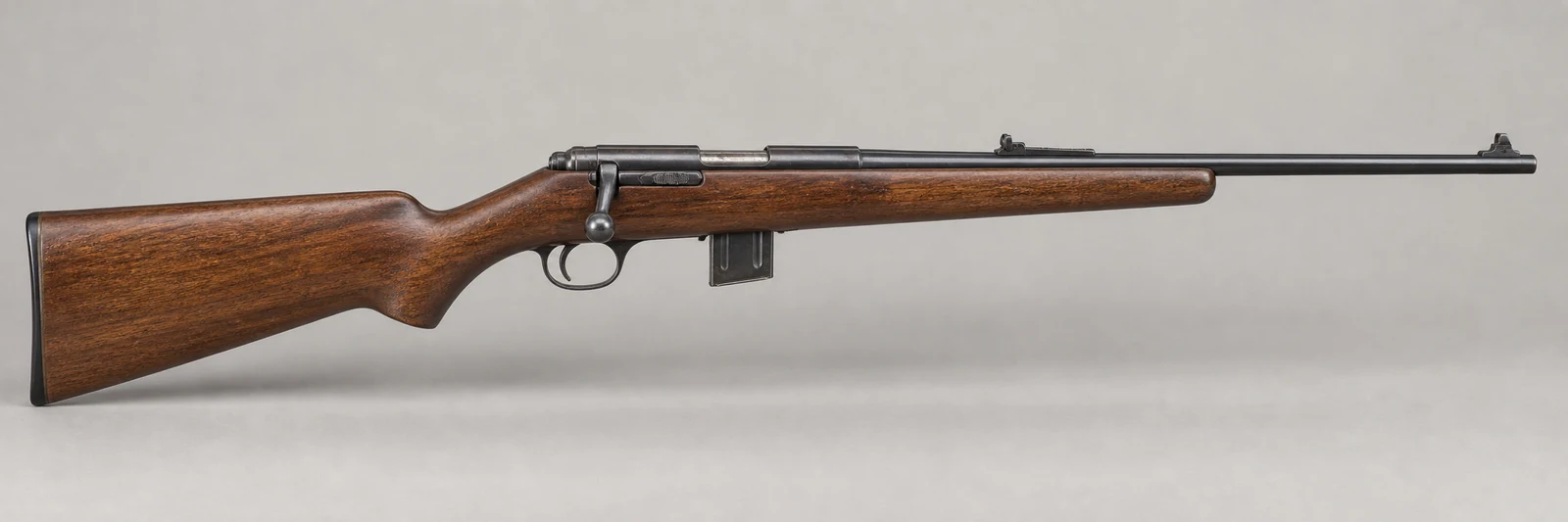
The Winchester Model 69 is a bolt-action, repeating .22 rimfire rifle produced from 1935 to 1963, with about 355,000 made across all variants.
- Produced:
- 1935–1963
- Action:
- bolt-action
New to gun terms? Start here
- Model:
- The name of the gun design, such as Model 94. A model name that looks like a year does not tell you when your gun was made.
- Serial number:
- The number stamped on an individual gun. Include letters that are part of the number. A separate letter stamped above it, like the Model 97's C, D or E, is a different marking.
- Receiver:
- The main metal body just behind the barrel. The receiver ring is its front section, where the barrel joins it.
- Tang:
- A strip of metal extending from the receiver into the stock. The lower tang runs underneath, behind the trigger.
- Stock:
- The part you hold against your shoulder, usually made of wood on older Winchesters.
- Forearm or forend:
- The part under the barrel where your forward hand holds the gun.
- Action:
- The mechanism that loads and removes cartridges. Names such as lever action, pump action, and bolt action describe how it works.
- Caliber or gauge:
- The ammunition size or type a gun is designed to use. This marking is different from the model and serial number.
- Takedown:
- A version designed to separate into major sections for storage. A takedown joint is where those sections meet.
- Proof mark:
- A factory testing mark, such as Winchester's oval WP stamp. It is not a serial number or a date code.
- Peep or aperture sight:
- A rear sight with a small hole to look through. A hooded front sight has a cover around it.
Most Model 69 guns have no serial number
Winchester never numbered the Model 69.
These guns usually have model and ammunition markings on the barrel, and may also have patent dates. Those are different from a serial number. The model’s production ended before federal law required serial numbers on rifles and shotguns in 1968. A missing number is normal for this model; it does not by itself show whether the gun has been altered.
355,363 were made across all variants between 1935 and 1963.
Designed by Frank F. Burton. A rifle marked Model 69 cocks on closing and has a prominent rear cocking piece; the Model 69A cocks on opening and has a sliding safety on the right side.
Without a factory serial number, a serial-number search cannot identify this individual gun. The feature clues below may help narrow its age.
If your Model 69 has a number on it
A number may be an owner’s mark, a store’s inventory number, or an importer’s mark. Some factory stamps identify an inspector or a part. On certain models, a two-digit stamp under the barrel can indicate a year. Patent dates describe patents, not when this particular gun was made. We do not have serial lookup tables for these markings.
How to date a Model 69 without a serial number
Winchester changed the Model 69 over its run, and the published references date some of those changes. These clues can help narrow the possible years:
- The improved 69A appeared in late 1937 and ran to 1963. Original 69 production overlapped it until 1939, and factory-scoped 69s until 1941.
- The scope-only Model 697 (1,431 made) and factory-scoped 69s with 32B open or 96B peep sights (769 made) date from 1937 to 1941.
- Target and Match versions were introduced in December 1940. Both are .22 Long Rifle only. The Target is identified by a Winchester 80 or 80B rear sight, a special stock and swivels, and the Match by a Lyman 57E or 57EW sight; neither has a heavier barrel or a special trigger.
- From February 1959 the Junior Target Shooter's Special replaced the Target, with a grooved receiver, Lyman 57EW rear and 93B front sights, and a forend swivel.
- Some barrels carry a two-digit year stamp on their underside, hidden by the stock. It dates the barrel, not the finished rifle: Winchester did not use parts up in the order they were made.
Features suggest a range of years. Winchester sometimes used older parts after a design changed, and parts may have been replaced later.
Winchester Model 69 value: what it sells for at auction
These prices come from 62 Winchester Model 69s sold individually at Morphy Auctions (2), Poulin Auctions (6), Redding Auction Services (28), and Amoskeag Auction Company (26) between Sep 2023 and Sep 2026. The age-group rows use the auction companies' categories: antique, curio and relic, or modern.
The typical price is the middle price, also called the median. Half sold for more and half for less. The middle 50% range leaves out the lowest quarter and highest quarter of prices. The wider 80% range leaves out the lowest tenth and highest tenth.
We leave out listings described as deluxe, special-order, engraved, restored, or commemorative, and other exceptions in the value guide. Commemoratives are priced on their own page. Wear, repairs, original parts, and factory upgrades can make a particular gun worth more or less. These figures are a comparison, not an appraisal of your gun.
| Category | Sales | Middle 50% of prices | Typical price | Middle 80% of prices |
|---|---|---|---|---|
| Curio & Reliccollector category, usually 50+ years old | 62 | $190 – $302 | $252 | $146 – $495 |
Curio & Relic: Redding Auction Services typical $255 (28 sales); Amoskeag Auction Company typical $242 (26 sales).
Recent Model 69 auction sales
Sales near the typical price and the newest. Their features and condition may differ from your gun. A lot number identifies an item in an auction.
| Sold | Gun | Auction company | Price |
|---|---|---|---|
| Jun 2026 | Model 69A | Amoskeag lot 2157 | $254 |
| Apr 2026 | Model 69A | Redding lot 438R | $250 |
| Feb 2026 | Model 69A | Redding lot 504R | $250 |
| Aug 2026 | Model 69A | Amoskeag lot 2757 | $121 |
| Aug 2026 | Model 69A | Amoskeag lot 2680 | $338 |
Prices are in US dollars and include the buyer’s premium, the auction company’s fee added to the winning bid, where the house charges one; Redding charges none. They are not the amount the seller receives. A dealer’s offer or private sale price may differ. The full picture, model by model →