 GunSerials
Winchester Model 75 serial numbers by year
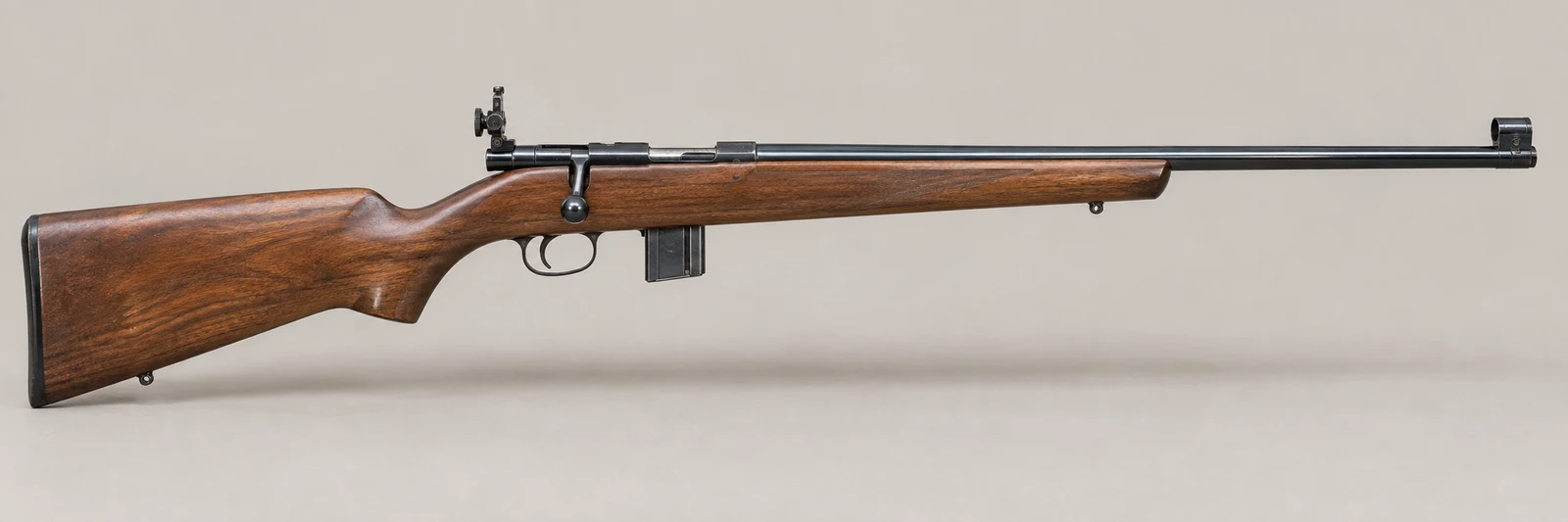
A bolt-action .22 rifle offered as a less expensive alternative to the Model 52.
- Produced:
- 1938–1958
- Action:
- bolt-action
New to gun terms? Start here
- Model:
- The name of the gun design, such as Model 94. A model name that looks like a year does not tell you when your gun was made.
- Serial number:
- The number stamped on an individual gun. Include letters that are part of the number. A separate letter stamped above it, like the Model 97's C, D or E, is a different marking.
- Receiver:
- The main metal body just behind the barrel. The receiver ring is its front section, where the barrel joins it.
- Tang:
- A strip of metal extending from the receiver into the stock. The lower tang runs underneath, behind the trigger.
- Stock:
- The part you hold against your shoulder, usually made of wood on older Winchesters.
- Forearm or forend:
- The part under the barrel where your forward hand holds the gun.
- Action:
- The mechanism that loads and removes cartridges. Names such as lever action, pump action, and bolt action describe how it works.
- Caliber or gauge:
- The ammunition size or type a gun is designed to use. This marking is different from the model and serial number.
- Takedown:
- A version designed to separate into major sections for storage. A takedown joint is where those sections meet.
- Proof mark:
- A factory testing mark, such as Winchester's oval WP stamp. It is not a serial number or a date code.
- Peep or aperture sight:
- A rear sight with a small hole to look through. A hooded front sight has a cover around it.
What year was your Model 75 made?
Need help finding the serial number?
Look up a serial number and print a one-page record sheet: the date and its sources, the status by age, the model in brief, and the auction price range.
Winchester Model 75 value: what it sells for at auction
Enter your serial number above to highlight the price categories that fit the estimated date and see recent sales of this model in those categories.
These prices come from 59 Winchester Model 75s sold individually at Rock Island Auction Company (2), Morphy Auctions (9), Poulin Auctions (10), Redding Auction Services (20), and Amoskeag Auction Company (18) between Sep 2023 and Sep 2026. The age-group rows use the auction companies' categories: antique, curio and relic, or modern.
The typical price is the middle price, also called the median. Half sold for more and half for less. The middle 50% range leaves out the lowest quarter and highest quarter of prices. The wider 80% range leaves out the lowest tenth and highest tenth.
We leave out listings described as deluxe, special-order, engraved, restored, or commemorative, and other exceptions in the value guide. Commemoratives are priced on their own page. Wear, repairs, original parts, and factory upgrades can make a particular gun worth more or less. These figures are a comparison, not an appraisal of your gun.
| Category | Sales | Middle 50% of prices | Typical price | Middle 80% of prices |
|---|---|---|---|---|
| Curio & Reliccollector category, usually 50+ years old | 59 | $472 – $1,058 | $590 | $387 – $1,568 |
Recent Model 75 auction sales
Sales near the typical price and the newest. Their features and condition may differ from your gun. A lot number identifies an item in an auction.
| Sold | Gun | Auction company | Price |
|---|---|---|---|
| May 2025 | Model 75 | Redding lot 270R | $590 |
| Nov 2025 | Model 75 | Morphy lot 1402 | $584 |
| Oct 2025 | Model 75 · 22 | Morphy lot 1445 | $584 |
| Aug 2026 | Model 75 | Amoskeag lot 2524 | $605 |
| Aug 2026 | Model 75 | Amoskeag lot 2284 | $484 |
Prices are in US dollars and include the buyer’s premium, the auction company’s fee added to the winning bid, where the house charges one; Redding charges none. They are not the amount the seller receives. A dealer’s offer or private sale price may differ. The full picture, model by model →
Where the serial number is
Right side of the front portion of the receiver.
Why the sources give different years
The dates for the Winchester Model 75 come from factory record books held at the Cody Firearms Museum, and George Madis's reference books. These sources can give different years for the same serial number. Original records usually provide stronger evidence than later estimates. Check the notes to see whether a source dates numbering, assembly, or another step.
Madis vs. factory dates shows examples from models whose tables disagree on this site.
Sources for this model: Madis year-end · CFM/PR or WACA year-end
Winchester Model 75 serial numbers by year
The full Model 75 serial number chart, one table for each source available here. Each row gives the numbers that source assigns to a year. Both the first and last numbers are included.
A row marked “sources differ” is a serial range that another table on this page dates to a different year. A row marked “estimate” is a figure its own source calls an estimate.
George Madis's published tables
George Madis compiled Winchester reference books years after production. His tables estimate the last serial number reached each year.
Cited as: Madis year-end
| Year | Serial numbers |
|---|---|
| 1938 | 1 – 1,198 |
| 1939 | 1,199 – 7,337 |
| 1940 | 7,338 – 13,256 |
| 1941 | 13,257 – 29,014 |
| 1942 | 29,015 – 35,439 |
| 1943sources differ | 35,440 – 35,484 |
| 1946sources differ | 35,485 – 39,804 |
| 1947sources differ | 39,805 – 46,592 |
| 1948sources differ | 46,593 – 55,913 |
| 1949sources differ | 55,914 – 68,652 |
| 1950 | 68,653 – 76,008 |
| 1951 | 76,009 – 79,479 |
| 1952 | 79,480 – 81,508 |
| 1953 | 81,509 – 82,481 |
| 1954 | 82,482 – 84,295 |
| 1955 | 84,296 – 85,027 |
| 1956 | 85,028 – 87,006 |
| 1957 | 87,007 – 88,714 |
| 1958sources differ | 88,715 – 89,338 |
- 1942: The factory records at the Cody Firearms Museum instead put serial 45,325 on October 12, 1942, the day numbering stopped for the war. That is the date the receiver was numbered, not the date it was assembled.
- 1943, 1946: The factory records at the Cody Firearms Museum show no receivers numbered in 1943 or 1944 and put these numbers in the 1942 run, which ended at 45,325. See the note on the war years below the tables.
- 1947: The factory records at the Cody Firearms Museum put 39,805 to 45,325 in 1942. They put 45,326 to 46,592 in 1945. No receivers were numbered in 1943 or 1944. George Madis's table places this whole range in 1947.
- 1958: The regular run of numbers reaches at least 88,715. A few more rifles were assembled from leftover parts in late 1957 and early 1958, with no firm final number. No single official final serial can be pinned down. The most that can be said is at least 88,715, or about 89,338 if you include later numbering and rifles assembled from leftover parts. The outside figure for later numbering and leftover-parts rifles is about 89,338, so this row ends there.
Factory records (Cody Firearms Museum)
Drawn from Winchester's original factory records. Numbering records date when serial numbers were stamped. The gun could be finished or shipped later; see this model's notes.
Cited as: CFM/PR or WACA year-end
| Year | Serial numbers |
|---|---|
| 1938 | 1 – 1,198 |
| 1939 | 1,199 – 7,337 |
| 1940 | 7,338 – 13,256 |
| 1941 | 13,257 – 29,014 |
| 1942sources differ | 29,015 – 45,325 |
| 1945sources differ | 45,326 – 49,097 |
| 1946sources differ | 49,098 – 55,862 |
| 1947sources differ | 55,863 – 58,500 |
| 1948sources differ | 58,501 – 63,500 |
| 1949estimate | 63,501 – 68,600 |
| 1950estimate | 68,601 – 75,955 |
| 1951estimate | 75,956 – 79,425 |
| 1952estimate | 79,426 – 81,448 |
| 1953estimate | 81,449 – 82,421 |
| 1954estimate | 82,422 – 84,235 |
| 1955estimate | 84,236 – 84,967 |
| 1956estimate | 84,968 – 86,946 |
| 1957estimate | 86,947 – 88,654 |
| 1958sources differ | 88,655 – 88,714 |
| 1959sources differ | 88,715 – 89,000 |
| 1960sources differ | 89,001 – 89,300 |
| 1961sources differ | 89,301 – 89,338 |
- 1938–1941: This figure comes from George Madis's tables.
- 1942, 1945: This figure comes from an original factory record at the Cody Firearms Museum.
- 1946–1948, 1958–1960: This figure is an estimate by the Winchester collectors' association.
- 1949–1957: This figure is an estimate by the Winchester collectors' association.
- 1961: This figure is an estimate by the Winchester collectors' association. Its historian says plainly that most postwar figures are estimates, because the original records for those years are privately held. No single official final serial can be pinned down. The most that can be said is at least 88,715, or about 89,338 if you include later numbering and rifles assembled from leftover parts.
What to know about Model 75 serial numbers
- There is no pre-1899 antique cutoff for this model. Production began in 1938.
- The sources disagree about the war years. The factory records at the Cody Firearms Museum, as read by the Winchester collectors' association, show that numbering stopped at 45,325 on October 12, 1942 and started again in October 1945, reaching 49,097 by December 5, 1945. No receivers were numbered in 1943 or 1944. George Madis's tables instead end 1942 at 35,439, show a small 1943 row (35,440 to 35,484), and do not reach 45,325 until 1947. The factory record is the original. If your serial number is between 35,440 and 45,325, the factory record puts it in 1942, not 1943 to 1947.
- Watch out with wartime receivers. Receivers numbered before or during the 1942 to 1945 break could be assembled much later, and they were not used up in number order.
- The postwar dates in the Winchester collectors' association online lookup are estimates. They are not copied from the ledger in the factory records at the Cody Firearms Museum. Do not treat them as exact factory dates.
- George Madis's tables say a few more rifles were assembled from leftover parts in late 1957 and early 1958, but give no firm final number.
- No single official final serial can be pinned down. The most that can be said is at least 88,715, or about 89,338 if you include later numbering and rifles assembled from leftover parts.
Winchester rifles usually made without serial numbers
These models usually have no serial number. Their pages explain the exceptions and how their features may help estimate age.
Need more detail? Check for factory records
The Cody Firearms Records Office can check for surviving records for your serial number. For a fee, it can issue a letter reporting what they say. Some records contain only dates; others also describe the gun’s original features.
The office’s May 2024 coverage sheet lists these Model 75 serial numbers: 36,722–49,097. Check current availability with the office before ordering; a listed range does not guarantee a record for every number.
Order a factory letter from the Cody Firearms Museum →What a factory letter shows, and when one is worth ordering →